Chatper 2 Literature Review on Tidal Flat Extent Determination

Tidal Flat Extraction and Change Analysis Based on the RF-W Model: A Example Study of Jiaozhou Bay, East Communist china
1
College of Geodesy and Geomatics, Shandong Academy of Science and Technology, Qingdao 266510, Communist china
2
State Key Laboratory of Resources and Environmental Information System, Institute of Geographic Sciences and Natural Resources Research, Chinese University of Sciences, Beijing 100864, People's republic of china
*
Author to whom correspondence should be addressed.
Academic Editors: Dimitris Poursanidis and Joong-Sun Won
Received: 21 February 2021 / Revised: 1 April 2021 / Accepted: 2 April 2021 / Published: viii April 2021
Abstract
Coastal tidal flats are important ecological resources. As the dividing line between marine and terrestrial ecosystems, tidal flats provide a large number of ecosystem services. However, with the excessive development of coastal areas, tidal flat resources have been drastically reduced, leading to the deterioration of coastal ecosystems. There is an urgent need to learn accurate information on the changes in tidal flat resources. This research proposes a tidal flat extraction model (RF-Westward model) that combines the random wood (RF) method and waterline method, which aims to ameliorate the accuracy of tidal flat extraction. This method can effectively eliminate the shortcomings of the RF method in determining the lower boundary of tidal flats and those of the waterline method in distinguishing river channels and tidal flats. The tidal apartment extraction of Qingdao Jiaozhou Bay in 2020 is performed as an example of the model. The results bear witness that the user's and producer'south accuracies of the RF-W model were both the highest, indicating that the improved model tin accurately excerpt tidal apartment information. So, we used the RF-Westward model to excerpt tidal flat information for Jiaozhou Bay in seven periods (1990, 1995, 2000, 2005, 2010, 2015, and 2020) and to study the spatiotemporal changes in the tidal flats and influencing factors from 1990 to 2020. The tidal flat surface area of Jiaozhou Bay showed an overall downward tendency before 2015, and the area decreased by 21.9 km2, with a reduction in the rate of approximately one.i%/year. Subsequently 2015, the tidal apartment area rebounded slightly. The overall modify in Jiaozhou Bay showed reclamation and expansion toward the body of water. The reduction in the sand content of the rivers entering the sea, reclamation and tillage, and land development were the main factors contributing to the reduction in the tidal apartment area in Jiaozhou Bay. In add-on, sea level rise due to climate warming is a long-term potential factor.
one. Introduction
Tidal flats refer to the tidal flooding zone between the high tide line and the low tide line in the littoral zone, and they are mostly distributed in estuaries [1]. As one of the near widely distributed ecosystems in coastal areas, tidal flats are the boundary between marine and terrestrial ecosystems and provide many ecosystem service functions [2]. For example, tidal flats support biodiversity and provide a habitat for a multifariousness of animals and plants [3]; equally a natural barrier for marine and terrestrial ecosystems, they tin can absorb multiple pollutants [4] and are an of import part of the "blue carbon" ecosystem, playing a role in carbon sequestration [5]. However, with the rapid development of coastal areas and the continuous movement of metropolis centers to coastal areas, tidal flats are sharply shrinking, disrupting the balance of the ecosystem and making tidal flats one of the nigh vulnerable areas on the planet. From 1989 to 2014, the area of tidal flats in the northern gulf almost the Mong Cai watershed, Vietnam, decreased by 208 kmtwo due to human activities and natural factors [6]. From 1990 to 2017, the area of tidal flats in the Yangtze River Delta decreased past 324 km2 at a rate of approximately 21.7 km2/twelvemonth [7]. In the by 50 years, the tidal flats along the Yellowish Sea have been reduced by more than fifty%, resulting in increased pollution, algae blooms, and loss of many animals and plants [viii]. Therefore, there is an urgent need to accurately measure the geographic location and surface area of undeveloped tidal flats and to understand the extent and causes of changes in developed tidal flats to protect and adjust land use planning [9,x].
Due to the poor accessibility of tidal apartment regions, field measurement data are scarce. With the rapid development of remote sensing technology, the richness of remote sensing datasets, and the diversity of data processing methods, information technology is possible to accurately excerpt tidal apartment information [11,12]. Many studies accept used edge detection or threshold partitioning to extract water lines and then obtain loftier tide lines and low tide lines to determine the tidal flat range and study its temporal and spatial changes [xiii,14,fifteen]. For instance, Qiu et al. (2019) used the normalized difference vegetation alphabetize (NDVI) combined with a threshold partitioning method to obtain the water and vegetation lines to extract tidal flats in the Yangtze River Delta and analyze their changes from 1975 to 2017 [7]. Sagar et al. (2017) used a large-calibration tide model combined with the normalized difference h2o alphabetize (NDWI) index to survey and map the coastal beaches of Commonwealth of australia [16]. Behling et al. (2018) used modified NDWI (mNDWI) time-series data to monitor changes in the coastline and tidal flats of the Gulf of Namibia from 1984 to 2014 [17]. Based on Landsat imagery, Wang et al. (2018) used the mNDWI and other vegetation indexes (NDVI and the enhanced vegetation index, EVI) to extract h2o and vegetation lines, to obtain an annual average water frequency map to decide the tidal flat range, and to generate a map of the coastal tidal flat changes in eastern Red china from 1986 to 2016 [eighteen]. Traditional extraction methods based on waterlines are affected by tidal conditions, remainder surface h2o, and other environmental parameters, resulting in inaccurate waterline extraction [13]. Moreover, because the intertidal zone contains some table salt-tolerant vegetation and tidal apartment streams, the waterline method cannot distinguish vegetation from tidal flats well, resulting in a subtract in the accuracy of tidal apartment extraction.
The intertidal zone is completely exposed at low tide, and it is continuously submerged at loftier tide. The tidal flat data extracted by remote sensing classification methods, such every bit visual estimation [19], supervised classification [twenty], and object orientation [21], represents only the instantaneous country when an epitome is caused. This phenomenon places high requirements on the fourth dimension and quality of image conquering, which hinders the rapid extraction and authentic assay of tidal flat information. With the rapid development of machine learning and the continuous comeback in the spatial and temporal resolution of remote sensing images, an increasing number of studies have appeared in the fields of automatic feature extraction and paradigm classification. As a motorcar learning algorithm, the random wood (RF) classification method can automate the feature extraction process, reduce piece of work costs, and meliorate efficiency [ten]. For example, Dubeau et al. (2017) used the RF classification method to classify the Dabs' wetland in Ethiopia, with an overall classification accuracy of 94.4% [22]. Gu et al. (2019) used the RF classification method to extract the data for the Wei-Ku haven wetland on the edge of the Tarim River, with an overall accuracy of ninety.1% [23]. Hou et al. (2020) used GF-1 images and combined out-of-bag (OOB) information to perform feature reduction and finally classified alpine wetlands with an RF classifier, with an overall classification accuracy of ninety.1% [24]. Although the RF nomenclature method has been widely used, the results of tidal apartment data extraction are greatly afflicted past the tidal conditions at the fourth dimension of data acquisition, which leads to shortcomings in the awarding of this method.
This study combines the advantages of the RF method and the waterline method in tidal flat extraction and proposes an improved RF-W tidal flat extraction model. First, multisource remote sensing images are used to excerpt tidal flat information in the study area through the RF classification method. 2d, the enhanced h2o boundary index (EWBI) of each image is calculated, and the waterline is extracted through threshold segmentation and edge detection of the EWBI information from the epitome. A digital shoreline analysis organisation (DSAS) is used to generate a loftier tide point set and a low tide betoken set up to decide the tidal flat range. Third, the lower boundary of the tidal flats obtained by the waterline method is used to right the tidal flat information obtained by the RF classification method to obtain more than accurate tidal flat data. Finally, the RF-W model proposed in this newspaper is used to extract the tidal flats in the Qingdao Jiaozhou Bay littoral zone at 5-twelvemonth intervals (1990–2020) and to study their temporal and spatial changes and influencing factors. This research volition provide methods and information support for sustainable management and ecological cess of coastal zones.
2. Materials and Methods
two.1. Written report Area and Data
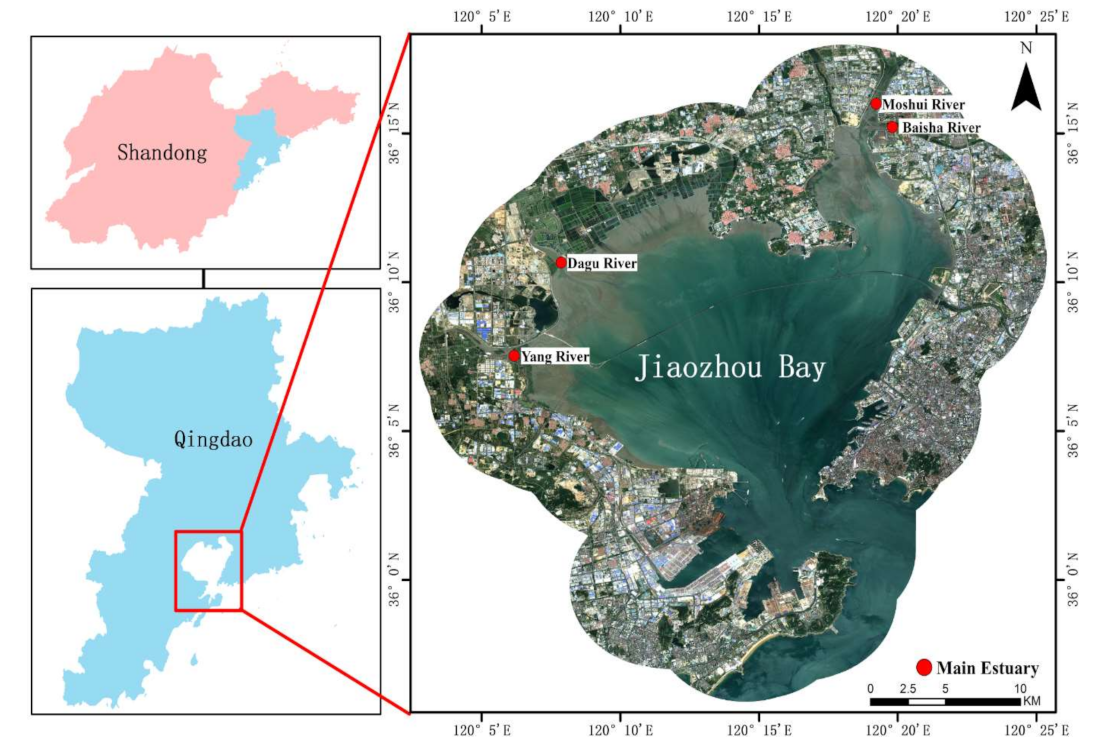
Jiaozhou Bay is located on the coast of the Yellow Sea on the due south coast of Communist china's Shandong Peninsula (36°01′Northward~36°fifteen′N, 120°03′Eastward~120°25′E). Jiaozhou Bay is the foundation of the formation and development of Qingdao and an important carrier of economical development; it is known as the "Mother Bay of Qingdao" (Figure 1). The terrain along Jiaozhou Bay gradually decreases from southeast to northwest, with mountains in the southward and southwest, plains in the north and northwest, and the Laoshan Mountains in the east. Jiaozhou Bay is a typical semienclosed bay with a total area of 446 km2, of which the wetland area is approximately 177.vi kmtwo [25]. More than than ten rivers flow along the declension of the bay. Among them, the Dagu River, Moshui River, and Baisha River deposit big amounts of sediment in their estuaries, resulting in arable tidal flat resource in Jiaozhou Bay, and these tidal flats are mainly distributed forth the northern and northwestern coasts of Jiaozhou Bay (Figure 1). The tidal flats in this study mainly refer to the intertidal zone, which is the area betwixt the average loftier tide level and depression tide level of the spring tide.
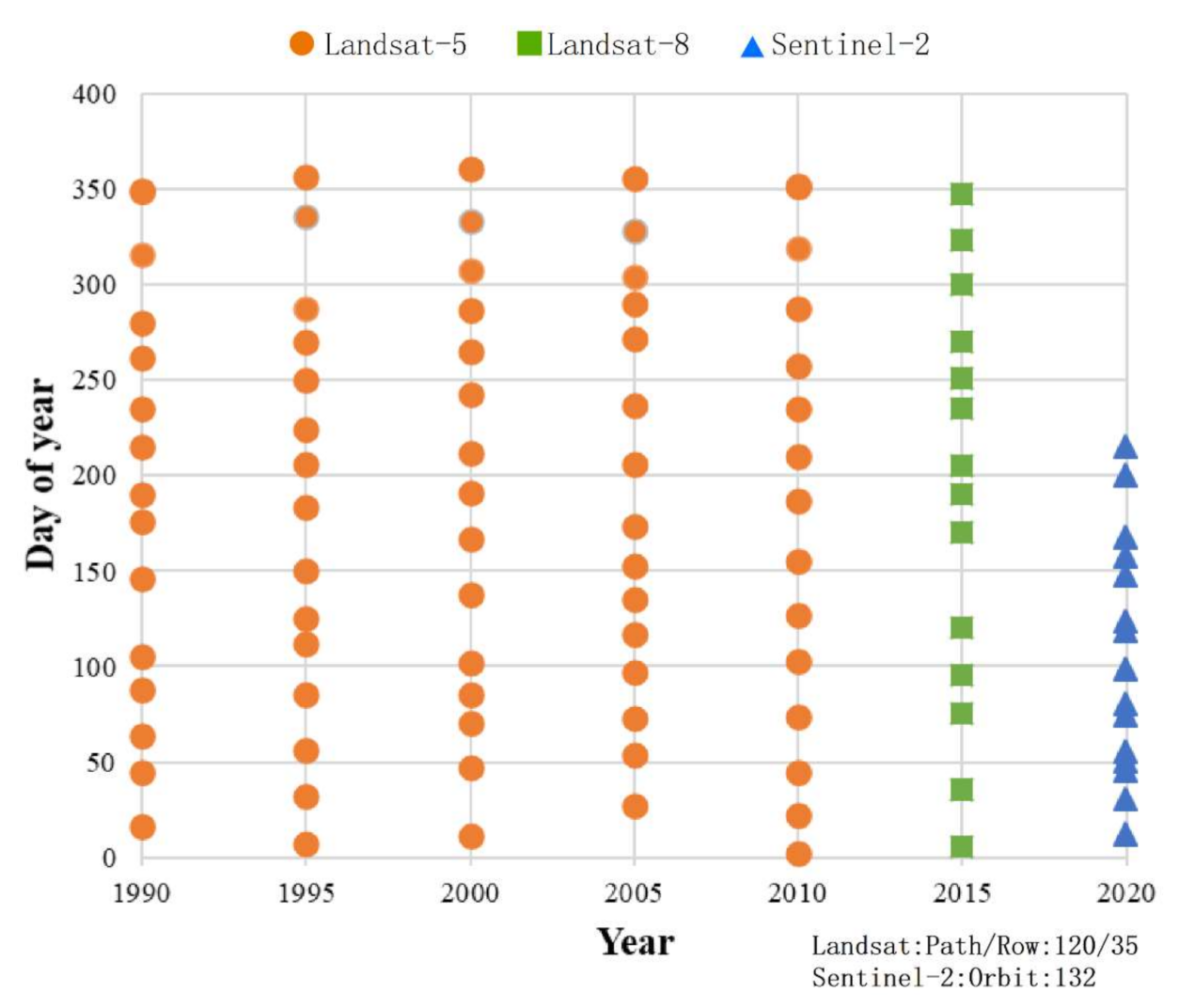
The remote sensing information used in the enquiry were mainly Lookout man-two images and Landsat images. From 1990 to 2020, a total of 102 images were obtained to extract tidal apartment data (Figure 2). Spotter-2 images (L1C) from the official website of the European Space Agency (ESA) (https://scihub.copernicus.eu/dhus/#/home; accessed on 12 September 2020) and the United States Geological Survey (USGS) (https://glovis.usgs.gov/app; accessed on 12 September 2020) cover 13 bands from visible light to shortwave infrared, with a maximum spatial resolution of x k and a revisit flow of 5 days. Landsat images were obtained from USGS, and the images included those captured by the OLI sensors and TM sensors. The OLI sensor included 9 multispectral bands and 1 panchromatic band, and the spatial resolution afterwards fusion can reach fifteen m; the TM sensor included 6 multispectral bands with 30 m spatial resolution and the revisit period was 16 days for both sensors. The selected images had express cloud coverage and loftier quality in the bay region. In addition, several Chinese GF-2 remote sensing images in 2020 were likewise included, with a spatial resolution of upwards to 1 m, which assisted in the collection of classified samples together with the loftier-resolution images in Google Earth.
The atmospheric correction needs to exist performed on the acquired images to obtain true surface reflectance information. Sentinel-2 (L1C) images were processed past the Sen2Cor-2.8.0 algorithm [26] published by the ESA and converted into L2A images, and and so the images were resampled to 10 m resolution through SNAP software and converted into ENVI standard format. The Sen2Cor algorithm was a plug-in released by the ESA for atmospheric correction of Sentry series images. The core of the algorithm was the atmospheric radiation transmission model libRadtran [27]. This model was suitable for diverse atmospheric weather condition, including the radiation, irradiance, and photochemical flux of the sun and function of Earth's spectrum. The Landsat image was corrected by the FLAASH atmospheric correction model in ENVI [28], and finally, the image to be classified in the Jiaozhou Bay area was obtained by cropping.
2.ii. Technical Procedure of Tidal Flats Extraction
When the RF classification method was used to excerpt tidal flats, the depression tide lines were not accurately adamant, which affects the accuracy of the extracted tidal flat data. The waterline method had sure advantages in determining the lower purlieus of tidal flats [29]. This research proposed a tidal flat extraction model (RF-W model) that combined the RF method and waterline method to achieve rapid and high-precision extraction of tidal flats. The specific technical process is shown in Effigy 3. (1) Decide the optimal partition parameters of the images to segment the images and select samples based on field survey information and loftier-resolution images; (2) build an RF nomenclature feature database and select suitable features; (3) extract tidal flat information through the RF algorithm; (four) based on time serial data, use the waterline method to excerpt the high tide line and depression tide line, and finally make up one's mind the lower boundary of the tidal flats; (5) use the lower boundary of the tidal flats adamant by the waterline method to modify the RF nomenclature algorithm to extract the tidal flats and generate a thematic map of tidal flats. In this technical procedure, the extraction of tidal flats in Jiaozhou Bay in 2020 was taken as an example to introduce the specific extraction procedure.
3. Results
iii.i. RF Method Extraction
3.1.1. Paradigm Partition
A multiscale algorithm combined with a spectral difference partition model was used to segment the image. The multiscale image partitioning algorithm was a region merging segmentation algorithm based on the minimum heterogeneity [30]. When segmenting, nosotros must kickoff analyze the spectral features and shape features of the objects in the image, and then set up the sectionalization parameters by a sure proportion co-ordinate to the importance of these features, gradually merge the homogeneous pixels from lesser to summit, and reduce the area of heterogeneous regions. Spectral difference sectionalization was based on multiscale segmentation, using the spectral reflectance difference between different features to optimize the results of multiscale sectionalization to achieve the all-time segmentation effect [31]. Therefore, when performing paradigm segmentation, the most important attribute is to discover the optimal segmentation scale and segmentation parameters.
This written report was based on the estimation of the scale parameter (ESP) plug-in in eCognition nine.0 software to summate the optimal partitioning calibration of the image to be classified [32]. This tool can calculate the impact of different segmentation scales on the local variance (LV) of the paradigm object, expressed equally the rate of change in LV (ROC-LV). When ROC-LV has an farthermost value, the division scale respective to this point is the local optimal segmentation scale. Effigy 4 shows that at that place are multiple local optimal segmentation scales. A segmentation scale that is too small-scale will fragment the tidal flats also much, and a segmentation calibration that is likewise large will cause other state types to exist included in the tidal apartment segmentation results. Therefore, combined with the completeness of the tidal apartment information in the segmentation results, the partition scale was fix to 90; the shape factor and the spectral gene were 0.2 and 0.viii, respectively; and the smoothness and compactness were both 0.five to divide the image. After the multiscale partitioning was completed, the event of spectral difference sectionalisation was optimized to obtain the final segmentation result.
3.1.2. Build a Nomenclature Feature Library
Earlier performing RF nomenclature, a classification feature database must be constructed. To accurately distinguish between h2o bodies and tidal flats, a serial of remote sensing indexes were calculated using ENVI 5.3 software to build a classification feature database, including the NDWI, automatic water body extraction alphabetize (AWElsh) [33], high-resolution water alphabetize (HRWI) [34], water index based on linear discriminant analysis (WI2015) [35] and an outcropping tidal flat extraction index (TFEI) [36]. Due to its loftier table salt content, salt-tolerant vegetation oft grows in tidal flats, and these vegetation types can exist distinguished by the NDVI. Additionally, the sliding window size was set to 3*3, the window moving distance was set to ane, and the quantized greyness level was ready to 8 to calculate the gray level co-occurrence matrix to obtain 8 texture features of the epitome. The brightness index (BI), greenness index (GI), and wetness index (WI) can be obtained through tasseled cap transformation [37,38]. The specific classification features and their calculation equation or clarification are shown in Tabular array 1.
3.1.3. RF Classification
The RF nomenclature algorithm is a information-driven nonparametric machine learning algorithm composed of multiple classifications and regression tree (CART) decision copse [39]. By sampling a large number of training samples with replacement North times, North training sample sets were obtained, and m classification features (one thousand ≤ M) were randomly selected from the total features 1000 in each sample set. Then, the nodes of the decision tree were divided past complete splitting, and N decision trees were constructed. In the prediction stage, afterwards each tree independently completes the prediction, a vote was made for the category of a new sample, and the prediction of the new sample was finally completed. Among many machine learning algorithms, the RF algorithm exhibited fast nomenclature speed and high accuracy and was insensitive to noise, and suitable for a variety of nomenclature scenarios.
A major advantage of the RF classification algorithm is that information technology can perform feature dimensionality reduction, reduce data redundancy, and improve nomenclature efficiency. During each random sampling process, one/3 of the data were not selected, and these unselected data were called OOB information. OOB data were used to calculate the feature variable importance score (VIS). The higher the VIS value is, the greater the contribution of the feature during classification. For any characteristic
, its VIS value is calculated by Equation (1).
In Equation (i),
represents the OOB mistake value calculated using the OOB data for each decision tree in the RF classification algorithm.
means that for whatsoever feature, with other features remaining unchanged, noise interference was practical to the feature variable, and the OOB error value was recalculated. In Equation (2), P is the full number of OOB data, and Q is the number of correct nomenclature results obtained by inputting OOB data into the random woods classifier.
Figure 5 shows the VIS value calculated from the OOB data for each characteristic. WI2015 had the largest contribution to the extraction of tidal flat data, with a VIS value exceeding 0.05, and the contribution of texture data was the smallest. Using the forward sequence departure method, each feature was put into the RF classifier for classification according to the VIS value, and the overall classification accuracy was calculated, as shown in Effigy v. With the continuous increase in the number of features, the overall accuracy (OA) continues to increase, and with the add-on of NDVI features, the OA tends to stabilize (Figure 5). Therefore, considering the time cost, 6 characteristic variables (WI2015, SWIR2, SWIR1, NIR/B, WI, and GI) with VIS values exceeding 0.04 and NDVI were selected as the input features of the RF classification algorithm.
3.1.4. Field Investigation and Reference Sample Selection
Co-ordinate to the existing country encompass research and tidal flat-related inquiry [40], combined with field investigation and enquiry needs, the land cover types in the study area were divided into tidal flats and nontidal flats, and the nontidal flats were divided into state, h2o, salt-tolerant vegetation, salt pans, and offshore ponds (Table two). The loftier-resolution satellite images from Google Globe and GF-two, as shown in Figure 6, indicated that all state cover types tin can be accurately identified. Taking country classification in 2020 equally an instance, referring to the high-resolution remote sensing images from Google Earth and field surveys, 2036 sample points were uniformly selected on the Sentinel-2 images in the study area—the quantity distribution of each blazon is shown in Table ii. Sample points were evenly distributed in the study area, 70% of which were used for classifier training and thirty% for accurateness evaluation.
3.1.v. Tidal Apartment Extraction by the RF Method
The RF nomenclature code was written in PyCharm integrated evolution environment based on libraries such as GDAL, Numpy, and Sklearn in Python 3.6. In full, 70% of the sample points were randomly selected as the training set, and the remaining xxx% were used equally the verification set. Since the RF classifier was composed of multiple decision copse, increasing the number of conclusion trees tin can ameliorate the classification accuracy, just when the number of copse was very large, the computational price will be high. Therefore, to meliorate accuracy and salve costs, the number of determination copse was prepare to 110, and the number of classification features was set to 7. RF classification was then performed. Then, the classification results were imported into ENVI 5.three software for post-classification processing, merging of adjacent homogeneous areas by cluster analysis, and modifying the misclassified parts through visual judgment to obtain the last classification information for tidal flats and various nontidal flats. Tidal flat data was derived for the post-obit research on tidal apartment extraction, and other nontidal flat information was used for alter analysis.
iii.ii. Waterline Extraction Method
Due to the influence of tidal weather, residual surface water, and regional restrictions, some traditional edge detection and threshold segmentation methods for extracting waterlines were less effective in extracting waterlines in Jiaozhou Bay than in other areas [41,42,43]. Therefore, this study proposes an EWBI for waterline extraction to minimize this inaccuracy. As shown in Effigy 7, the EWBI index proposed by this enquiry was compared with the country surface water index (LSWI) and mNDWI indexes, which can better place the h2o body boundary and improve the accuracy of waterline extraction.
M is the greenish band of the remote sensing images, NIR is the near-infrared band, and SWIR1 is the shortwave infrared band 1.
First, the EWBI was proposed based on the difference in spectral reflectance between tidal flats and nontidal flats forth Jiaozhou Bay, as shown in Equation (3). This index tin highlight the boundary of the waters along Jiaozhou Bay and yield an accurate instantaneous waterline. Second, the EWBI image was segmented with 0 as the threshold to generate a binary image of land and h2o. And so, the Canny operator was used to detect whether each pixel was an edge pixel to extract the waterline. Finally, the extracted waterline was revised through visual estimation. To extract tidal flat information, the outermost low tide waterline was selected equally the lower boundary of the tidal flats, and the innermost high tide waterline was selected as the upper boundary of the tidal flats [14].
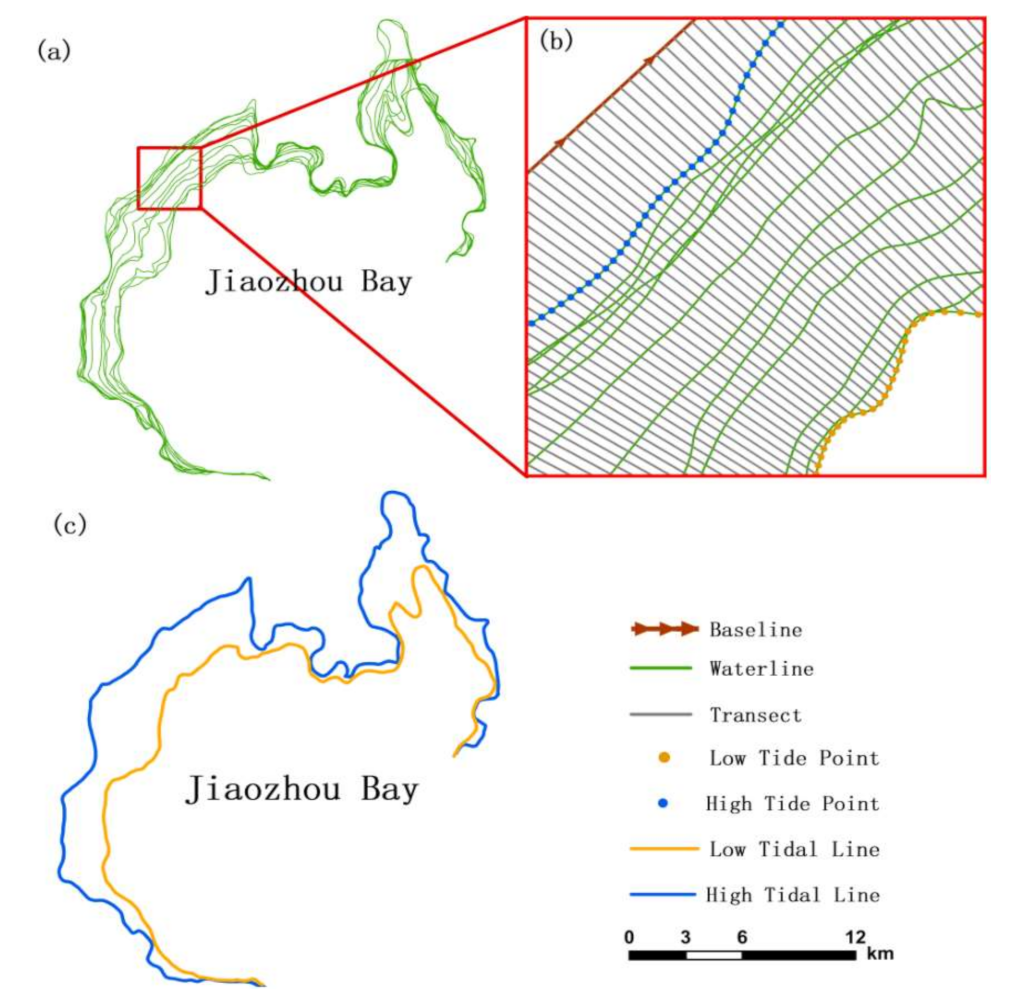
Due to changes in daily tide levels, atmospheric condition, and other factors, the tidal movement in the aforementioned area may vary, causing different water lines to cantankerous each other. To determine the accurate tidal flat range, the DSAS plug-in in ArcGIS software was used to generate a cross-department every 100 1000 along the coastline of the study area. The intersection of the cross-section and the waterline was considered the tidal point, which represents the instantaneous tide level at the fourth dimension of satellite overpass. The altitude between each tide point and the baseline was calculated for each section. The nearest and farthest points from the baseline were selected to course a high tide betoken set and low tide indicate gear up, respectively, and all high tide points and low tide points were continued to determine the annual high tide line and low tide line. Finally, the upper and lower boundaries of the tidal flats were determined in this written report (Figure viii).
Fifteen Sentinel-two images in the study area in 2020 were selected for the tidal apartment waterline extraction experiments. First, the EWBI values were calculated to extract the waterlines of fifteen images through methods such equally threshold segmentation, edge detection, and visual interpretation, and the results are shown in Figure 8a. Second, the DSAS tool was used to generate a cross-department every 100 m for a total of 990 cross-sections. Each department generated xv tide points forth the waterline, for a total of 14,850 tide points. The distance between each tide point and the baseline was calculated in each section, and the farthest point from the baseline and the nearest point were filtered out, constituting the loftier tide point set and low tide point set, as shown in Effigy 8b. Finally, all the high tide points and low tide points were connected to generate the annual loftier tide line and low tide line, as shown in Figure 8c. In this manner, the area between the concluding high and low tide lines in Figure 8c was the tidal flat surface area of Jiaozhou Bay in 2020 obtained by the waterline method.
iii.iii. RF-W Model Extraction
The results of tidal flat extraction through the RF method and the waterline method showed that the extracted tidal flat range was roughly the same, but in that location were some differences in the details (Effigy 9a). Compared with the waterline method, the tidal flats extracted past the RF method were more detailed, allowing the effective distinguishing of rivers, tidal flats, and creeks and the authentic extraction of tidal flats (Figure 9a(i)). The waterline method used multiple images to extract low tide point sets to determine the lower purlieus of the tidal flats, which was a more than accurate process than the RF method (Figure 9a(ii)). Therefore, we combined the two methods, adopted the shaping element tool in ArcGIS, and revised the extraction results of the RF method based on the lower purlieus of the tidal flat extracted by the waterline method. Kickoff, select the shaping element tool in the editor toolbar to select a point in the extraction result of the RF method, then select the trace element tool to identify the lower boundary extracted past the waterline method, and finally, return to the starting bespeak to class a closed curve to obtain the final tidal flats extraction issue (Figure 9b).
three.4. Accuracy Evaluation
To verify the accuracy of the tidal apartment information extracted in this research, a confusion matrix was used for accuracy evaluation [44]. The 30% sample dataset used for accuracy verification described in Section iii.1.4 was divided into two sets of tidal flats and nontidal flats, including 120 tidal flat verification points and 480 nontidal flat verification points. The confusion matrix of the three methods was calculated to obtain the terminal extraction accuracy, as shown in Table 3, Table 4 and Table 5. The tables show that both the user's accuracy and producer's accuracy of the RF-W model were the highest, which were 3.iii% and 5.3% higher than those of the RF method alone, and the user's accuracy and producer's accurateness of the waterline method were the lowest. These results indicated that the RF-Due west model tin finer improve the accurateness of tidal flat information extraction.
4. Discussion
four.i. Overall Changes in Tidal Flats
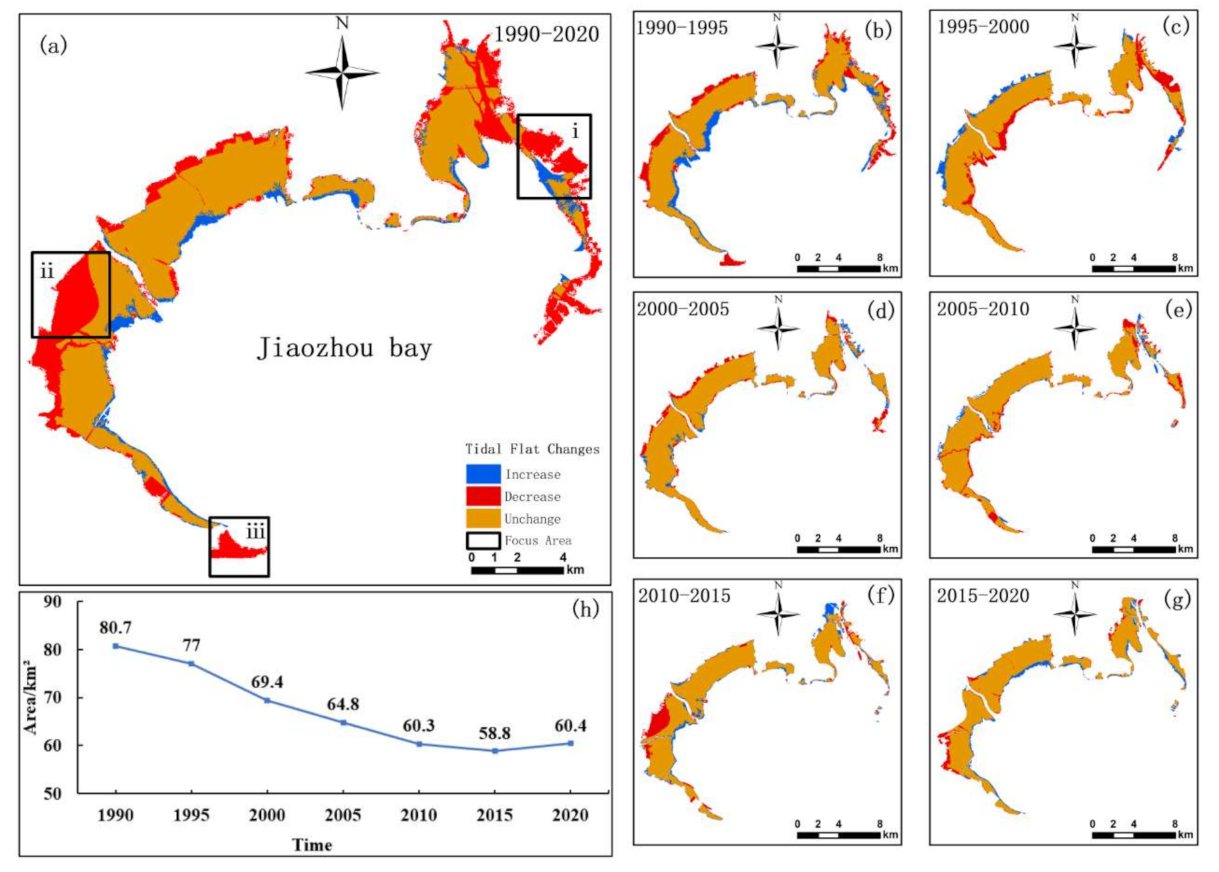
The RF-West model proposed in this study was used to extract the tidal flats of Jiaozhou Bay in 1990, 1995, 2000, 2005, 2010, 2015, and 2020 (Figure 10). The tidal flats of Jiaozhou Bay are mainly distributed along the western, northern, and northeastern coasts of the gulf. Since 1990, the overall tidal apartment area has shown a downwards trend (Figure 10h). The tidal flat area reached the lowest value of 58.eight kmtwo in 2015, later which there was a rebound, with the area reaching lx.4 km2 in 2020. The expanse of tidal flats decreased by twenty.3 km2 over 30 years, representing a reduction of 25.ii%. The regions with large changes in the tidal flats are mainly located near the eastern bank of the Moshui River estuary (Figure 10a(i)), the southern depository financial institution of the Dagu River estuary (Figure 10a(ii)), and the southern shore of Jiaozhou Bay (Figure 10a(iii)). The overall change tendency is mainly presented as tidal flat reclamation and sea expansion.
4.ii. Tidal Flat Changes in Focus Areas
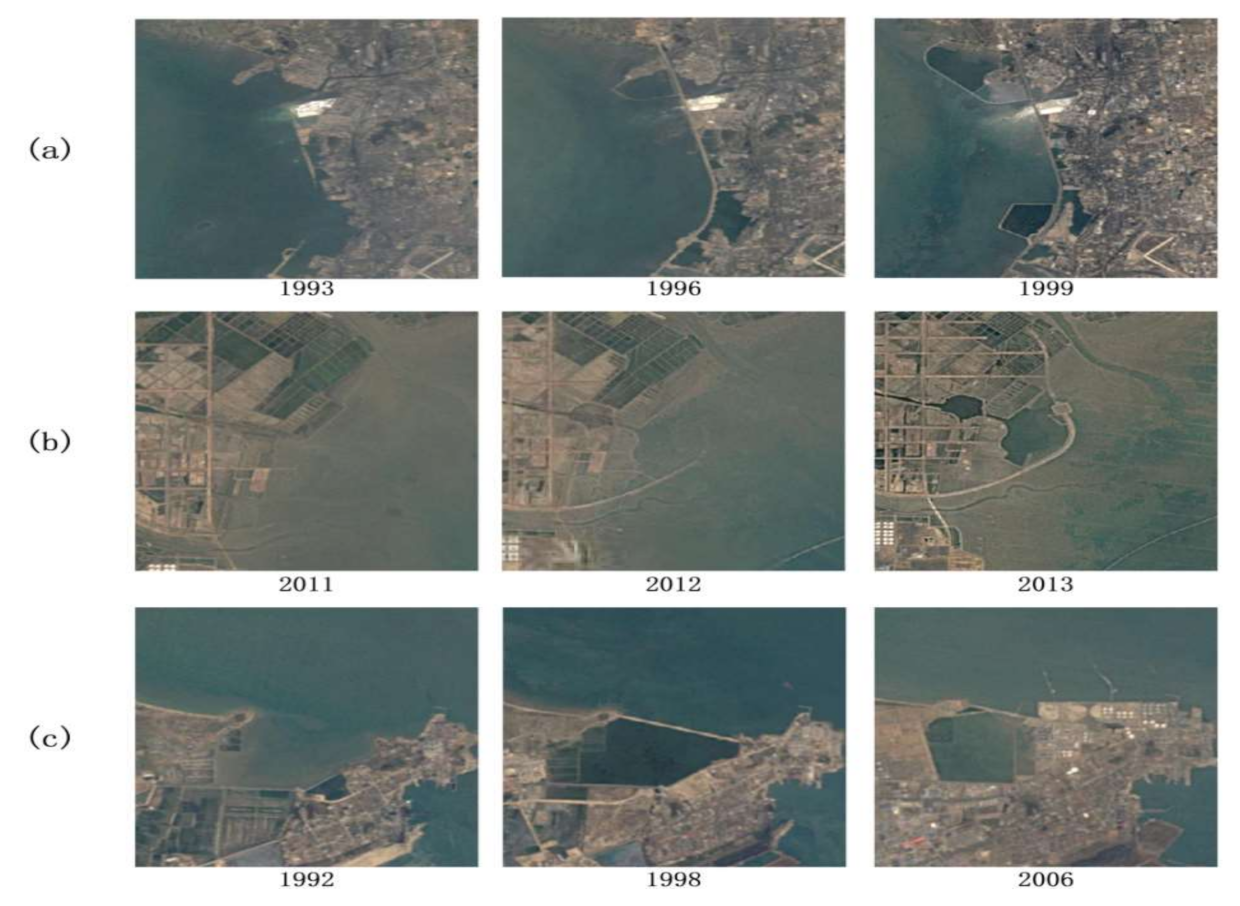
The surface area near Banqiaofang on the northeastern shore of Jiaozhou Bay, located to the east of the Moshui River, is a focus area for country reclamation in Qingdao (Figure 10a(i)). Beginning in 1995, the coastal area of Banqiaofang began to repossess the sea area, resulting in a reduction in tidal flat area by approximately ii.ix km2 (Figure 11a). In 1997, due to the construction of the Jiaozhou Bay Expressway, the shoreline became straighter and moved toward the sea by a large margin. Big areas of tidal flats disappeared and turned into roads and residential areas.
The southwestern shore of Jiaozhou Bay, located in the expanse south of the Dagu River, is next to the western coast of Huangdao and is another focus surface area for country reclamation in Qingdao (Figure 10a(ii)). In the past xxx years, Qingdao has made vigorous efforts to develop Huangdao District, and the original agricultural and fishery economic system has been gradually replaced by sectors such as manufacture, commerce, and port-related activity. Large-scale land reclamation and the construction of factories have caused the tidal apartment area to subtract. In 2010, due to large-scale urbanization, the surface h2o permeability decreased, and the requirements for flood storage and discharge greatly increased. To meet the flood storage requirements, tidal flat reclamation was carried out on the northern banking concern of the Yanghe River, and the Yuejin River flood control dike was synthetic. As shown in Figure 11b, this dike was basically completed past the end of 2013, reducing the tidal apartment expanse by approximately 5.iii kmii.
The southern banking company of Jiaozhou Bay is located in the northeastern sea expanse of the community of Xiaoshitou and is likewise a focus area for reclaiming and building ports (Figure 10a(3)). With the establishment of the Qingdao economic and technological development zone, Huangdao District's industry has developed chop-chop, and the demand for ports has increased, resulting in frequent seaport building activities. As shown in Figure 11c, the reclamation project started in the northeastern bounding main expanse of Xiaoshitou in 1992. By 1998, the sea reclamation project was basically completed, and the port structure project was mostly completed by 2006. The project construction led to a reduction in tidal apartment area past approximately 1.9 kmii.
4.iii. Analysis of the Causes of Tidal Flat Changes
4.3.ane. Straight Crusade
Coastal tidal flats are formed by rivers carrying sediment to the body of water and nearby coast via an estuary. The tidal apartment expanse depends on the relationship between sediment deposition and the hydrodynamic environment and is also affected by human being factors. For Jiaozhou Bay, the interference of man activities dominates. Jiaozhou Bay is a semiclosed bay with superior natural conditions and rich fishery resources, providing people with an platonic living environment. Therefore, the tidal flats in this area are extremely susceptible to interference by human activities. The estuary of the Jiaozhou Bay River is mainly concentrated in the Dagu River estuary and Yanghe River Estuary in the northwest, and the Moshui River estuary and Baisha River estuary in the northeast (Effigy 1). The tidal flat expanse in this region accounts for 80% of the total surface area of tidal flats in Jiaozhou Bay. Afterwards 2000, the regulation of the Dagu River, Yanghe River, Moshui River, and Baisha River began to increase. Reservoir dams were built upstream, and the interception of sediment reduced the sediment flux from the river to the sea, which affected the evolution of estuary beaches. The regulation of runoff past dams also affected the evolution of estuary beaches to a certain extent [45,46].
Because of the benefits of fish and salt in the bay and the convenience of boats providing good development conditions, sea reclamation and state reclamation are too of import factors affecting the changes in the tidal flats of Jiaozhou Bay [47,48]. In the 1990s, with the significant improvement in China'due south economical development, the rate of reclamation in Jiaozhou Bay accelerated, and a large area of tidal flats was used for marine aquaculture. The area used for marine aquaculture increased quickly from 11 km2 in 1986 to 33 kmii in 2000, accounting for xl% of the entire reclamation area [49]. Additionally, transportation also began to develop rapidly: The construction of the highway around Jiaozhou Bay made the eastern coastline straighter and moved the coastline toward the sea past a large margin, and a big number of beaches disappeared. With the vigorous development of Huangdao Commune later 2000, most reclamation activities in Jiaozhou Bay were concentrated in the Huangdao Qianwan Port and Gratis Trade Zone and Xuejiadao Coastal Shipyard. Ports and industries take go new factors affecting reclamation. With the promulgation and implementation of the Sea Area Management Measures in 2002, sea area use rights were determined by collecting ocean surface area usage fees, reclamation activities were restricted by law, and the rate of sea reclamation in Jiaozhou Bay decreased. Therefore, the human activities along Jiaozhou Bay have had an important impact on the littoral changes.
iv.3.2. Underlying Forces
Government control is likewise an important factor affecting the changes to the tidal flats in Jiaozhou Bay. Since Qingdao was listed as one of fourteen open up coastal cities in 1984, the regime has encouraged economic development in this area, which has led to a rapid increment in population and has resulted in over-cultivation, weakened upstream soil fixation capacities, increased soil erosion, and increased river sediment loads. These factors caused gradual silting at the downstream entrance to the sea and increased the tidal apartment expanse [fifty,51]. Additionally, large-scale reclamation activities transformed a large area of tidal flats into aquaculture ponds, which led to a subtract in the tidal apartment area. In September 2014, the Qingdao Municipal Government formally implemented local regulations such every bit the "Regulations on the Protection of Jiaozhou Bay of Qingdao City" and implemented 5 major projects, including river improvement, dye source improvement, render to the sea, ecological restoration, and greenway construction around the bay. The construction of wetland parks and wetland protection areas led to a slight rebound in the tidal apartment area of Jiaozhou Bay after 2015.
In addition, with the warming of the climate and the intensification of the greenhouse result, the sea level has gradually risen, which has likewise become one of the factors affecting the changes in the tidal flats of Jiaozhou Bay. According to the data from the China Sea Level Message of the State Oceanic Administration, the sea level in Jiaozhou Bay will keep to fluctuate and rise, and it is estimated that by 2050, the body of water level of Shandong Province volition have risen by 5–xix cm. Due to ocean level rise, the beach surface of the silted bank will gradually become steeper, and the upwards convex shape will go larger. The erosion of the beach surface will gradually slow, and the upward concave shape will tend to go straight. The change in the embankment surface shape is bound to take an touch on the development of the beach, resulting in a decrease in the surface area of the embankment [52]. Furthermore, the weakening of the hydrodynamic force, the reduction in tidal capacity, the reduction in h2o commutation and the reduction in seawater conveying capacity due to reclamation volition crusade an increment in the tidal apartment area [53,54]. Although the influence of these factors is a long-term and slow procedure, their potential impacts on the evolution of tidal flats cannot be ignored.
4.iv. The Harm Caused by Tidal Flat Changes
The ever-increasing reclamation activities take directly led to a reduction in tidal flat resources in Jiaozhou Bay, causing incalculable harm to the coastal surroundings and ecosystem. The tidal flats forth Jiaozhou Bay are key habitats for fish spawning and migration, sources of nutrient for migratory birds, and areas of animal and plant growth. Large-calibration reclamation activities have converted a large number of tidal flat wetlands along Jiaozhou Bay, resulting in a big reduction in the biological species in the tidal flat wetlands and the endangerment or local disappearance of ecological service functions [55]. On the declension of Jiaozhou Bay, activities such as aquaculture, port docks, and port industries accept increased the discharge of pollutants into the sea, while the reduction in tidal flats has weakened the self-purification capacity of the sea expanse. The pollution of the shore water environs and sedimentary environment has continued to intensify As Jiaozhou Bay is a semi-closed harbor, this kind of take a chance volition become more prominent.
five. Conclusions
With the excessive evolution of coastal areas, tidal flat resources have been continuously reduced, and at that place is an urgent need to accurately sympathise their distribution and the factors driving the modify. This report proposes an improved model (RF-W model) for tidal apartment extraction, which combines the RF method and the waterline method, and carries out model verification through the extraction of tidal flats in Jiaozhou Bay in 2020. The results show that the accuracy is distinctly better than those of the RF method and waterline method alone and demonstrate that the RF-W model tin exist applied for the extraction of large-scale tidal apartment information and farther spatiotemporal change analysis.
Data on tidal flats in the Jiaozhou Bay from 1990 to 2020 was extracted by the RF-West method, and the results showed a downward tendency over the past thirty years. The total tidal flat area decreased by approximately 20 km2, of which the area decreased by nearly 17 km2 from 1995 to 2010, accounting for 85% of the total subtract. The areas with large changes were mainly located on the southern bank of the Dagu River estuary and the areas near the two banks of the Moshui River estuary. The overall alter mainly reflected tidal apartment reclamation and expansion toward the body of water and changes in the sediment content of rivers inbound the sea. Human activities, such every bit reclamation, land evolution, and government policies, are the main factors affecting the tidal flat changes in Jiaozhou Bay. Over the long term, glacier melting and sea level rise due to climate warming and the greenhouse effect, as well equally changes in hydrodynamics and tidal assimilation due to reclamation, are too potential factors leading to the changes in the tidal flats in Jiaozhou Bay.
Author Contributions
Conceptualization, J.Y. and S.Z. (Shiyi Zhao); formal analysis, Southward.Z. (Shiyi Zhao) and J.D.; funding acquisition, J.Y. and F.South.; methodology, S.Z. (Shiyi Zhao), J.D., P.F., and S.Z. (Shixun Zhang); writing—original draft, S.Z. (Shiyi Zhao); writing—review and editing, J.Y., F.S., and Southward.Z. (Shiyi Zhao). All authors have read and agreed to the published version of the manuscript.
Funding
This research was funded by the Chinese Academy of Sciences Strategic Leading Special A "Earth Big Data Scientific discipline Project" (XDA19060300) and the Major Science and Technology Innovation Projects of Shandong Province (2019JZZY020103).
Institutional Review Lath Argument
Not applicable.
Informed Consent Argument
Not applicable.
Information Availability Statement
The data presented in this study are available on request from the corresponding writer.
Acknowledgments
We appreciate the critical and constructive comments and suggestions from the reviewers that helped improve the quality of this manuscript. We would also like to offer our sincere thanks to those who participated in the data processing and provided constructive comments for this study.
Conflicts of Interest
The authors declare no disharmonize of interest.
References
- Li, C.; Wang, P.; Fan, D. Tidal flats, open ocean coasts. In Encyclopedia of Coastal Science; Springer: Berlin/Heidelberg, Germany, 2005; pp. 975–978. [Google Scholar]
- Millennium Ecosystem Assessment, M.E.A. Ecosystems and Human Well-Existence; Island Printing: Washington, DC, U.s., 2005. [Google Scholar]
- Pocket-sized, C.; Nicholls, R.J. A Global Assay of Human Settlement in Coastal Zones. J. Coast. Res. 2003, 19, 584–599. [Google Scholar]
- Tian, B.; Wu, W.; Yang, Z.; Zhou, Y. Drivers, trends, and potential impacts of long-term coastal reclamation in China from 1985 to 2010. Estuar. Coast. Shelf Sci. 2016, 170, 83–ninety. [Google Scholar] [CrossRef]
- Ma, Z.; Melville, D.South.; Liu, J.; Chen, Y.; Yang, H.; Ren, W.; Zhang, Z.; Piersma, T.; Li, B. Rethinking Cathay's new great wall. Scientific discipline 2014, 346, 912–914. [Google Scholar] [CrossRef] [PubMed]
- Tong, Due south.S.; Deroin, J.P.; Pham, T.L. An optimal waterline arroyo for studying tidal flat morphological changes using remote sensing data: A case of the northern coast of Vietnam. Estuar. Declension. Shelf Sci. 2020, 236, 106613. [Google Scholar] [CrossRef]
- Qiu, C.Y.; Li, X.; Liu, S.A.; Chen, D. Monitoring tidal flats in the Yangtze River Delta using Landsat images. J. Geo-Inf. Sci. 2019, 21, 269–278. [Google Scholar]
- Murray, Northward.J.; Ma, Z.; Fuller, R.A. Tidal flats of the Yellow Bounding main: A review of ecosystem status and anthropogenic threats. Austral Ecol. 2015, 40, 472–481. [Google Scholar] [CrossRef]
- Wang, H.; Bi, North.; Saito, Y.; Wang, Y.; Dominicus, Ten.; Zhang, J.; Yang, Z. Recent changes in sediment commitment by the Huanghe (Yellow River) to the sea: Causes and environmental implications in its estuary. J. Hydrol. 2010, 391, 302–313. [Google Scholar] [CrossRef]
- Zhang, K.Y.; Dong, X.Y.; Liu, Z.Grand.; Gao, W.X.; Hu, Z.W.; Wu, Thousand.F. Mapping Tidal Flats with Landsat 8 Images and Google Earth Engine: A Example Written report of the People's republic of china's Eastern Coastal Zone circa 2015. Remote Sens. 2019, eleven, 924. [Google Scholar] [CrossRef]
- Liu, X.; Gao, Z.; Ning, J.; Yu, X.; Zhang, Y. An Improved Method for Mapping Tidal Flats Based on Remote Sensing Waterlines: A Instance Study in the Bohai Rim, China. IEEE J. Sel. Acme. Appl. Earth Obs. Remote Sens. 2016, ix, 5123–5129. [Google Scholar] [CrossRef]
- Zhao, Y.; Liu, Q.; Huang, R.; Pan, H.; Xu, 1000. Recent Evolution of Coastal Tidal Flats and the Impacts of Intensified Human Activities in the Modern Radial Sand Ridges, East Red china. Int. J. Environ. Res. Public Health 2020, 17, 3191. [Google Scholar] [CrossRef]
- Ryu, J.-H.; Won, J.-S.; Min, K.D. Waterline extraction from Landsat TM information in a tidal apartment: A case written report in Gomso Bay, Korea. Remote Sens. Environ. 2002, 83, 442–456. [Google Scholar] [CrossRef]
- Liu, Y.; Huang, H.; Qiu, Z.; Fan, J. Detecting coastline change from satellite images based on embankment gradient estimation in a tidal flat. Int. J. Appl. Earth Obs. Geoinf. 2013, 23, 165–176. [Google Scholar] [CrossRef]
- Tseng, K.-H.; Kuo, C.-Y.; Lin, T.-H.; Huang, Z.-C.; Lin, Y.-C.; Liao, West.-H.; Chen, C.-F. Reconstruction of fourth dimension-varying tidal apartment topography using optical remote sensing imageries. ISPRS J. Photogramm. Remote Sens. 2017, 131, 92–103. [Google Scholar] [CrossRef]
- Sagar, S.; Roberts, D.; Bala, B.; Lymburner, L. Extracting the intertidal extent and topography of the Australian coastline from a 28 year fourth dimension series of Landsat observations. Remote Sens. Environ. 2017, 195, 153–169. [Google Scholar] [CrossRef]
- Behling, R.; Milewski, R.; Chabrillat, S. Spatiotemporal shoreline dynamics of Namibian coastal lagoons derived by a dense remote sensing fourth dimension series approach. Int. J. Appl. World Obs. Geoinf. 2018, 68, 262–271. [Google Scholar] [CrossRef]
- Wang, X.; Xiao, Ten.; Zou, Z.; Chen, B.; Ma, J.; Dong, J.; Doughty, R.B.; Zhong, Q.; Qin, Y.; Dai, Southward.; et al. Tracking annual changes of littoral tidal flats in China during 1986–2016 through analyses of Landsat images with Google World Engine. Remote Sens. Environ. 2020, 238, 110987. [Google Scholar] [CrossRef] [PubMed]
- Zhang, Z.; Wang, X.; Zhao, X.; Liu, B.; Yi, L.; Zuo, L.; Wen, Q.; Liu, F.; Xu, J.; Hu, Southward. A 2010 update of National Land Employ/Cover Database of China at ane:100000 calibration using medium spatial resolution satellite images. Remote Sens. Environ. 2014, 149, 142–154. [Google Scholar] [CrossRef]
- Murray, N.J.; Phinn, Due south.R.; DeWitt, M.; Ferrari, R.; Johnston, R.; Lyons, M.B.; Clinton, N.; Thau, D.; Fuller, R.A. The global distribution and trajectory of tidal flats. Nature 2019, 565, 222–225. [Google Scholar] [CrossRef]
- Whyte, A.; Ferentinos, K.P.; Petropoulos, Thousand.P. A new synergistic approach for monitoring wetlands using Sentinels -i and 2 data with object-based machine learning algorithms. Environ. Model. Softw. 2018, 104, 40–54. [Google Scholar] [CrossRef]
- Dubeau, P.; King, D.J.; Unbushe, D.G.; Rebelo, L.-M. Mapping the Dabus Wetlands, Federal democratic republic of ethiopia, Using Random Wood Nomenclature of Landsat, PALSAR and Topographic Data. Remote Sens. 2017, ix, 1056. [Google Scholar] [CrossRef]
- Gu, F.; Ding, J.Fifty.; Wang, J.Z.; Ge, Y.Ten. Data Extraction of Wetlands in Typical Oasis Based on Random Forest Model. Red china Rural H2o Hydropower 2019, 6, 44–50. [Google Scholar]
- Hou, M.J.; Yin, J.P.; Ge, J.; Li, Y.C.; Feng, Q.S.; Liang, T.G. Land Embrace Remote Sensing Classification Method of Alpine Wetland Region Based on Random Forest Algorithms. Trans. Chin. Soc. Agric. Mach. 2020, seven, 220–7227. [Google Scholar]
- Lin, R. Research on the Theoretical Strategy of Qingdao Ecological Environment and Landscape Protection. Ph.D. Thesis, Beijing Forestry University, Beijing, People's republic of china, 2016. [Google Scholar]
- Mackert, K.; Lazard, A.; Liang, Thou. Scale and validation program for the l2A processor and products of the Lookout-2 mission. Int. Arch. Photogramm. Remote Sens. 2015, Xl-7/W3, 1249–1255. [Google Scholar]
- Mayer, B.; Kylling, A. Technical notation: The libRadtran software package for radiative transfer calculations-description and examples of use. Atmos. Chem. Phys. 2005, 5, 1855–1877. [Google Scholar] [CrossRef]
- Qi, 10.; Tian, J. The advances in the study of atmospheric correction for optical remote sensing. Remote Sens. Land Resour. 2005, 17, 1–6. [Google Scholar]
- Cao, W.; Zhou, Y.; Li, R.; Li, X. Mapping changes in coastlines and tidal flats in developing islands using the full time series of Landsat images. Remote Sens. Environ. 2020, 239, 111665. [Google Scholar] [CrossRef]
- Ma, Y.; Ming, D.; Yang, H. Estimation of Maximum Heterogeneity Parameters for Object-Oriented Epitome Multi-scale Segmentation. J. Remote Sens. 2017, 4, 522–578. [Google Scholar]
- Chen, Q.Y.; An, Y.L.; Zhou, Ten.; Wu, Ten.; Xi, Due south.J.; Hao, X.C. Extraction of Land Use Data in Different Karst Geomorphic Areas Based on Multi-scale and Spectral Departure Segmentation of GF-ane Epitome. Carsologica Sin. 2019, 5, 785–794. [Google Scholar]
- Drǎguţ, 50.; Tiede, D.; Levick, S.R. ESP: A tool to judge scale parameter for multiresolution image segmentation of remotely sensed data. Int. J. Geogr. Inf. Sci. 2010, 24, 859–871. [Google Scholar] [CrossRef]
- Feyisa, Grand.Fifty.; Meilby, H.; Fensholt, R.; Proud, S.R. Automated Water Extraction Index: A new technique for surface water mapping using Landsat imagery. Remote Sens. Environ. 2014, 140, 23–35. [Google Scholar] [CrossRef]
- Yao, One thousand.; Luo, Y. Improved random forests and its application to nomenclature of remote sensing image. Comput. Eng. Appl. 2016, 52, 168–173. [Google Scholar]
- Fisher, A.; Flood, N.; Danaher, T. Comparing Landsat water index methods for automated water nomenclature in eastern Commonwealth of australia. Remote Sens. Environ. 2016, 175, 167–182. [Google Scholar] [CrossRef]
- Lu, Y.; Yang, Y.; Huang, P.; Shu, X.; Lin, X. Method for Quickly Extracting Beach Area of Exposed H2o Surface. CN201910912106.1. 25 September 2019. [Google Scholar]
- Crist, E.P. A TM Tasseled Cap Equivalent Transformation for Reflectance Factor Data. Remote Sens. Environ. 1985, 17, 301–306. [Google Scholar] [CrossRef]
- Crist, E.P.; Kauth, R.J. The Tasseled Cap De-mystified. Photogramm. Eng. Remote Sens. 1986, 52, 81–86. [Google Scholar]
- Breiman, L. Random forests. Mach. Learn. 2001, 45, 5–32. [Google Scholar] [CrossRef]
- Pang, L.; Kong, F.; 11, M.; Li, Y.Q. Assay of State Apply Change in Jiaozhou Bay Littoral Zone. Wetl. Sci. 2017, v, 680–688. [Google Scholar]
- Chen, L.C. Detection of shoreline changes for tideland areas using multi-temporal satellite images. Int. J. Remote Sens. 1998, xix, 3383–3397. [Google Scholar] [CrossRef]
- Zhao, C.; Qin, C.; Teng, J. Mapping large-area tidal flats without the dependence on tidal elevations: A instance study of Southern People's republic of china. ISPRS J. Photogramm. Remote. Sens. 2020, 159, 256–270. [Google Scholar] [CrossRef]
- Chen, Y.; Dong, J.; Xiao, X.; Zhang, Chiliad.; Tian, B.; Zhou, Y.; Ma, Z. Land merits and loss of tidal flats in the Yangtze Estuary. Sci. Rep. 2016, vi. [Google Scholar] [CrossRef]
- Congalton, R.G.; Green, Thousand. Assessing the Accuracy of Remotely Sensed Information: Principles and Practices; CRC Printing: Boca Raton, FL, U.s.a., 2008. [Google Scholar]
- Yang, Y.P.; Li, Y.T.; Fan, Y.Y.; Zhang, J.H. Bear upon of water and sediment discharges on subaqueous delta evolution in Yangtze Estuary from 1950 to 2010. Water Sci. Eng. 2014, 7, 331–343. [Google Scholar]
- Wang, H.; Wu, X.; Bi, N.; Li, Due south.; Yuan, P.; Wang, A.; Nittrouer, J. Impacts of the dam-orientated h2o-sediment regulation scheme on the lower reaches and delta of the Xanthous River (Huanghe): A review. Glob. Planet. Chang. 2017, 157, 93–113. [Google Scholar] [CrossRef]
- Ma, Y.; Li, G.; Shi, J. Remote Sensing Analysis of the Present Situation of Dagu Estuary Wetland in Jiaozhou Bay. Catamenia. Body of water Univ. China 2006, 36, 179–184. [Google Scholar]
- Chen, Z.; Wang, W.; Wu, South. Introduction to the Gulf of Red china.Beijing; Beijing Ocean Press: Beijing, China, 2007. [Google Scholar]
- Lei, Northward.; Hu, X.; Zhou, X. Development process and ecological effect analysis of reclamation in Jiaozhou Bay. Mar. Environ. Sci. 2013, four, 506–509. [Google Scholar]
- Li, X.; Zhou, Y.; Zhang, 50.; Kuang, R. Shoreline alter of Chongming Dongtan and response to river sediment load: A remote sensing assessment. J. Hydrol. 2014, 511, 432–442. [Google Scholar] [CrossRef]
- Dai, S.B.; Lu, X.X.; Yang, S.L.; Cai, A.Thousand. A preliminary guess of human and natural contributions to the turn down in sediment flux from the Yangtze River to the Eastward Mainland china Ocean. Quat. Int. 2008, 186, 43–54. [Google Scholar] [CrossRef]
- Yang, G.; Shi, Y.; Ji, Z. The morphological response of typical mud flat to body of water level change in Jiangsu littoral plain. Acta Geographica Sinica 2002, 57, 76–84. [Google Scholar]
- Tang, L.; Lu, D.; Zhao, H. Summary of research on the touch on of estuary beach reclamation on hydrodynamic environment. Adv. Sci. Technol. Water Resour. 2020, 40, 78–84. [Google Scholar]
- Muller, J.R.M.; Chen, Y.; Aarninkhof, S.G.J.; Chan, Y.-C.; Piersma, T.; van Maren, D.S.; Gong, Z. Ecological touch on of land reclamation on Jiangsu coast (China): A novel ecotope cess for Tongzhou Bay Water. Sci. Eng. 2020, thirteen, 57–64. [Google Scholar] [CrossRef]
- Hou, Ten.Y.; Zhang, H.; Li, D.; Hou, West.; Vocal, Y. Evolution trend, environmental and ecological impacts, and policy recommendations for Bohai Body of water reclamation. Acta Ecol. Sin. 2018, 38, 3311–3319. [Google Scholar]
Figure one. Location of the study area and remote sensing paradigm (GF-2).
Figure ane. Location of the study surface area and remote sensing image (GF-ii).
Effigy ii. Acquisition time of remote sensing images.
Figure 2. Acquisition time of remote sensing images.
Effigy iii. Workflow used in this study for tidal flat extraction.
Effigy 3. Workflow used in this study for tidal flat extraction.

Figure four. Evaluation of sectionalisation calibration.
Figure 4. Evaluation of segmentation calibration.
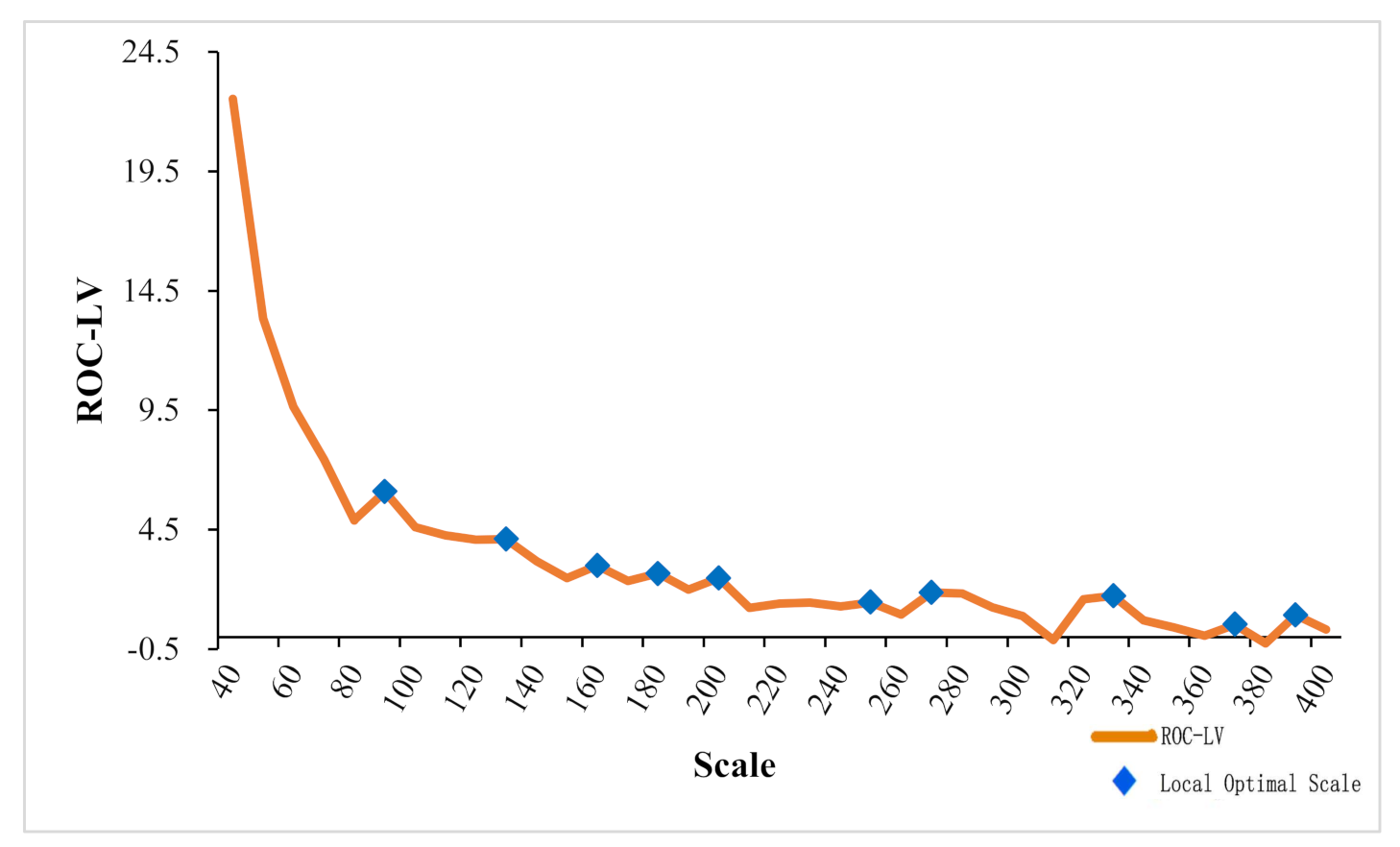
Figure v. Changes to the VIS value and OA of each characteristic with the number of features. (Notation: The reference image is a Scout-2 remote sensing image taken on 26 February 2020, with an orbit number of 132).
Effigy 5. Changes to the VIS value and OA of each feature with the number of features. (Note: The reference epitome is a Scout-2 remote sensing image taken on 26 February 2020, with an orbit number of 132).

Figure six. Interpreted areas on loftier-resolution remote sensing image (GF-ii). (a) Tidal flat; (b) common salt-tolerant vegetation; (c) salt pan; (d) breeding pond.
Figure 6. Interpreted areas on loftier-resolution remote sensing paradigm (GF-two). (a) Tidal flat; (b) salt-tolerant vegetation; (c) salt pan; (d) convenance pond.
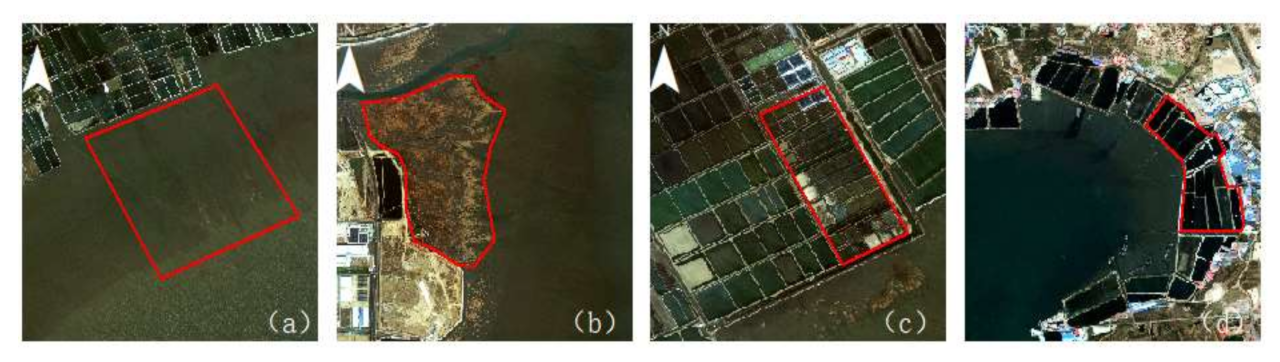
Figure 7. Comparison of three waterline extraction algorithms. (a) The reflectance deviation of barren mudflat and seawater; (b) LSWI; (c) mNDWI; (d) EWBI > 0.
Figure vii. Comparing of iii waterline extraction algorithms. (a) The reflectance difference of arid mudflat and seawater; (b) LSWI; (c) mNDWI; (d) EWBI > 0.
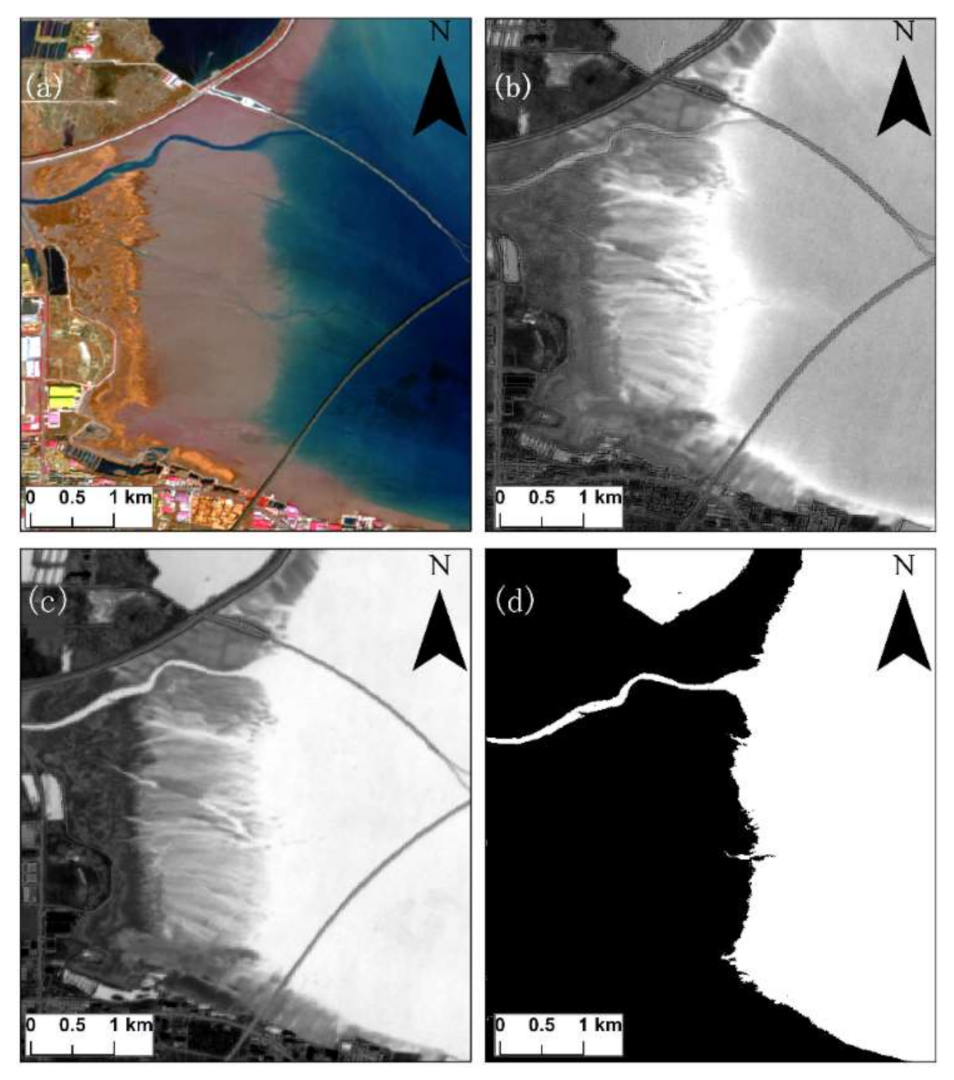
Figure 8. Loftier and depression tide line extraction procedure by the waterline method. (a) Waterline extraction results; (b) high and low tide betoken extraction results; (c) high and depression tide line extraction results.
Figure 8. High and low tide line extraction process by the waterline method. (a) Waterline extraction results; (b) loftier and low tide betoken extraction results; (c) high and low tide line extraction results.
Effigy ix. Combination of the RF method and waterline method to extract tidal flats. (a) Comparison of the extraction results of the two methods; (b) RF-W model extraction result.
Figure 9. Combination of the RF method and waterline method to excerpt tidal flats. (a) Comparing of the extraction results of the two methods; (b) RF-W model extraction event.

Figure x. Changes in the tidal flats in Jiaozhou Bay from 1990 to 2020. (a) Overall changes; (b) 1990–1995; (c) 1995–2000; (d) 2000–2005; (eastward) 2005–2010; (f) 2010–2015; (g) 2015–2020; (h) modify in tidal apartment expanse.
Figure ten. Changes in the tidal flats in Jiaozhou Bay from 1990 to 2020. (a) Overall changes; (b) 1990–1995; (c) 1995–2000; (d) 2000–2005; (due east) 2005–2010; (f) 2010–2015; (g) 2015–2020; (h) change in tidal apartment area.
Effigy 11. Schematic diagram of tidal flat changes in focus areas. (a) Along the shore of Banqiaofang; (b) on the northern depository financial institution of the Yanghe River; (c) forth the northeastern coast of the community Xiaoshitou.
Effigy 11. Schematic diagram of tidal flat changes in focus areas. (a) Along the shore of Banqiaofang; (b) on the northern bank of the Yanghe River; (c) along the northeastern coast of the community Xiaoshitou.
Tabular array 1. Classification features and equations.
Table 1. Classification features and equations.
| Feature Name | Feature Abbreviation | Calculation Equation or Clarification |
|---|---|---|
| Band | Band | Ring 1~Band 12 |
| Normalized Departure Vegetation Index | NDVI | |
| Normalized Departure H2o Index | NDWI | |
| Automatic Water Torso Extraction Index | AWElsh [33] | |
| Water Index Based on Linear Discriminant Analysis | WI2015 [35] | |
| High-Resolution Water Index | HRWI [34] | |
| Outcropping Tidal Apartment Extraction Index | TFEI [36] | |
| Brightness Index | BI [37,38] | Tasseled cap transformation first component |
| Greenness Index | GI [37,38] | Tasseled cap transformation 2nd component |
| Wetness Index | WI [37,38] | Tasseled cap transformation tertiary component |
| Grayness Level Co-occurrence Matrix | GLCM | GLCM1~GLCM8 |
Tabular array ii. Country cover types and their corresponding sample numbers.
Tabular array 2. Land cover types and their corresponding sample numbers.
| Grade | Description | Number | Surface area | |
|---|---|---|---|---|
| Tidal Flats | Tidal Flats | A tidal apartment located between the average high and depression tide lines | 401 | nineteen.7% |
| Non-Tidal Flats | Table salt-tolerant Vegetation | Table salt-tolerant vegetation located on the embankment and in the sea | 211 | x.4% |
| Convenance Ponds and Table salt Pans | Fish ponds and salt pans along the declension | 102 | v.0% | |
| Land | Construction land, cultivated state, woodland and unused state | 633 | 31.1% | |
| Water | River and sea | 689 | 33.eight% | |
| Full | 2036 |
Table 3. RF method confusion matrix.
Table 3. RF method confusion matrix.
| Tidal | Other | ∑ | Producer's Accurateness (%) | |
|---|---|---|---|---|
| Tidal | 108 | nineteen | 127 | 85.0 |
| Other | 12 | 461 | 473 | 97.v |
| ∑ | 120 | 480 | ||
| User's accuracy (%) | 90.0 | 96.0 | ||
| Overall accurateness (%) | 94.eight |
Table four. Waterline method defoliation matrix.
Table 4. Waterline method confusion matrix.
| Tidal | Other | ∑ | Producer's Accuracy (%) | |
|---|---|---|---|---|
| Tidal | 101 | 31 | 132 | 76.v |
| Other | 19 | 449 | 468 | 95.9 |
| ∑ | 120 | 480 | ||
| User's accuracy (%) | 84.2 | 93.5 | ||
| Overall accuracy (%) | 91.seven |
Table 5. RF-Westward method confusion matrix.
Table 5. RF-W method confusion matrix.
| Tidal | Other | ∑ | Producer's Accurateness (%) | |
|---|---|---|---|---|
| Tidal | 112 | 12 | 124 | 90.3 |
| Other | 8 | 468 | 476 | 98.3 |
| ∑ | 120 | 480 | ||
| User'south accuracy (%) | 93.3 | 97.five | ||
| Overall accuracy (%) | 96.vii |
| Publisher's Note: MDPI stays neutral with regard to jurisdictional claims in published maps and institutional affiliations. |
© 2021 by the authors. Licensee MDPI, Basel, Switzerland. This article is an open access article distributed nether the terms and conditions of the Creative Commons Attribution (CC By) license (https://creativecommons.org/licenses/past/4.0/).
Source: https://www.mdpi.com/2072-4292/13/8/1436/htm
0 Response to "Chatper 2 Literature Review on Tidal Flat Extent Determination"
Postar um comentário