How Does an Element Family Group Determine Its Reactivity With Water
Limestone composition and reactivity are critical factors that determine the operation of limestone-based wet flue gas desulfurization systems. Limestone quality affects sulfur dioxide (And then2) removal, reaction tank sizing, limestone consumption rate, and composition of the gypsum product and waste matter streams. Reactivity is a straight measure of how readily a limestone will provide alkalinity to neutralize the acid resulting from SOtwo dissolution in h2o. In this article nosotros review your limestone analytic measurement options and discuss their relative accuracy and limitations.
Limestone is a ordinarily occurring sedimentary stone, predominantly composed of calcium and magnesium carbonate (MgCO3) with diverse amounts of silicates, metal oxides, and other impurities. Mineralogically, limestone may be regarded as calcite, magnesian calcite, dolomite, or an aggregate with varying proportions of each of these minerals.
Pure calcite exists as crystals of calcium carbonate (CaCO3) with a rhombohedral unit cell. A limestone becomes dolomitized as magnesium ions are integrated within the calcite matrix, magnesium substituting for calcium on a one-to-ane atomic basis. Limited integration of magnesium produces magnesian calcite. Consummate dolomitization occurs when an equimolar ratio of CaCO3 and MgCO3 exists within the lattice.
Substitution of MgCO3 into the crystal matrix is an exothermic reaction. As a result, the dolomite and, to a lesser extent, magnesian calcite, are more thermodynamically stable structures than pure calcite. Therefore, the lattice strength is increased equally magnesium is incorporated. Like calcite, the basic crystal structure of dolomite is rhombohedral, with magnesium occupying every other position from calcium on the cation plane.
The convention within industry has been to assume that all of the MgCO3 in limestone is dolomitic, with an equimolar tooth ratio of MgCO3 and CaCO3. Actually, the molar ratio of these species can vary considerably from crystal to crystal, and the reactivity of each crystal varies in relation to the fraction of MgCO3 in the crystal. Most limestones selected for moisture flue gas desulfurization (WFGD) awarding are highly calcitic, containing less than 5% MgCOiii.
Limestone for Sulfur Removal
Accurate decision of limestone composition and reactivity are crucial in the option of reagents for WFGD applications, peculiarly for systems producing commercial grade gypsum products. (See Seminole Generating Station story, p. 52.) Although systems tin can be synthetic to utilize a wide range of limestone composition and reactivity, limestone quality must exist agreed upon early during organisation pattern because this parameter affects unit sizing, product quality, wastewater handling, limestone consumption rate, and WFGD organisation functioning.
Mineral species of interest are calcite, magnesian calcite, and dolomite. The magnesian calcite or substituted calcites range from 6% to thirteen% magnesium replacement of calcium in the crystal structure. As well of business organization are the silicates and metallic oxides, which are inert in the WFGD process simply affect gypsum purity; concentrations of these inerts in the gypsum are oft limited to specific levels for commercial course gypsum product.
Though the use of lower-quality limestone may provide an advantage in system operating cost, the do good of these savings should exist weighed against impacts on system performance. Limestone of acceptable quality is necessary for achieving design-level functioning.
WFGD System Chemistry
Pulverized limestone is used in WFGD absorbers to provide alkalinity for reaction with SO2 from the flue gas. Within a WFGD organization, SOtwo dissolves into the aqueous slurry, where dissociation occurs and produces sulfurous acid. Acid undergoes a heterogeneous reaction with the surface of limestone particles, yielding calcium cations and hydrogen carbonate anions within the slurry. The hydrogen carbonate then undergoes acrid-base neutralization, producing carbon dioxide (COii) and water. Within the absorber reaction tank — in add-on to limestone dissolution, acrid neutralization, and CO2 stripping — sulfite is oxidized to sulfate, and the calcium ions, sulfate, and h2o later react to class a gypsum product.
Gypsum composition and purity are dependent upon limestone composition. When limestone possessing depression bachelor CaCO3 is fed to the system, limestone feed rates must increase to provide the same level of SO2 removal. In so doing, both limestone consumption and the level of impurities, including CaCO3, within the slurry will increase. Consequently, the gypsum purity and quality will decrease. Several means of determining limestone composition are available.
Thermogravimetric Analysis (TGA). TGA is an analytical technique that tin can exist used to determine the proportion of unlike mineralogical species within a limestone sample. This method harnesses the differences in thermal decomposition temperatures of limestone constituents to determine composition past measuring weight loss equally a function of temperature. As a limestone sample is heated in a stream of CO2 gas, its weight decreases every bit decomposition occurs from the increased temperature. Sample weight loss is interpreted as a weight fraction of CO2 evolved, by taking the ratio of sample weight to the full original sample weight.
Mineralogical structure affects the decomposition temperature of a compound. Carbon dioxide is evolved from CaCO3 and from the MgCO3 jump within dolomite and magnesian calcite at dissimilar temperature ranges (Table one). Initially, h2o, organics, and impurities are driven off at low temperatures. After this bespeak, decomposition of the carbonate species within limestone begins.

Table 1. Estimate decomposition temperatures for limestone. Source: B&Westward
It's important to note that magnesium may exist bound within the dolomite or as magnesian calcite. Nonetheless, precise quantification of the magnesium content within the magnesian calcite phase past TGA is difficult due to the spectrum of magnesium concentrations that may exist inside magnesium-substituted calcites and due to concentrations within the sample approaching the detection limit of the TGA. A potent subtract in weight is frequently associated with CO2 loss from the MgCOiii inside the dolomitic structure. Afterwards COii loss attributed to MgCO3 species, CO2 is evolved as from decomposition of CaCO3, irrespective of mineral phase.
Analysis of TGA data is based upon sample weight loss equally a office of temperature and the derivative of this office (Figures i and 2). The total sample weight loss is calculated on a CO2 basis, providing a direct measurement of full carbonate within the sample.

1. TGA data for NIST SRM 1d. Source: B&W
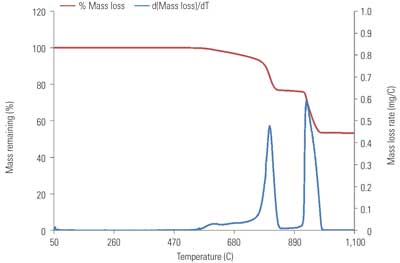
2. TGA data for NIST SRM 88b. Source: B&W
The derivative of the weight loss vs. temperature part provides a ways to quantify the CO2 associated with magnesium species. The dolomitic tiptop is integrated to beget a value for the COii weight loss assigned to dolomitic MgCOiii. Due to its low concentrations in limestone, the MgCOiii associated with magnesian calcite seems to be outside of the TGA detection limit and indistinguishable from the baseline of this derivative function for most limestones. The departure between the total CO2 weight loss and dolomitic MgCOiii weight loss is attributed to CaCO3 decomposition. Such an approximation entails grouping the MgCOiii associated with magnesian calcite into the value for full CaCOiii.
X-Ray Fluorescence (XRF). XRF is a widely bachelor, rapid, and toll-constructive technique for elemental analysis. It also offers the benefit of quantifying many elements simultaneously, including such species as silicon and various metals.
During XRF, a specimen is irradiated by a high-energy Ten-ray beam. Energy is released in wavelengths characteristic of specific elements. The total energy released in each characteristic wavelength is proportional to the amount of that element present. These wavelengths are used to identify the elements present in a specimen. Concentrations of the elements are adamant by relating the measured radiation to analytical curves from reference materials of known composition.
Wet Chemical Test Methods. Wet chemical test methods are used in combination to provide results that could exist obtained from a single XRF or TGA analysis. These methods are frequently labor-intensive and more expensive than the other techniques discussed.
The TAPPI train is a gravimetric methodology for determining the total CO2 fraction of a limestone sample. Oxalate titration is a method for determining the calcium content of a limestone sample. Ammonium phosphate gravimetric methodology is used to determine the magnesium content of a limestone sample.
Laboratory Testing Results
To compare the accuracy of different techniques for limestone analysis, a dolomitic limestone control (NIST SRM 88b) and an argillaceous limestone control (NIST SRM 1d) were selected for testing by TGA, XRF, and moisture chemical test methods. NIST SRM 88b has a relatively high MgCOthree content and exhibits low reactivity due to the dolomitic content. In contrast, NIST SRM 1d is highly calcitic and would exist more representative of a WFGD reagent limestone. Multiple belittling runs were conducted on each of these limestone samples using the various techniques.
Composite samples of NIST SRM 1d spiked with NIST SRM 88b were created for TGA and XRF analysis, such that low quantities of the dolomitic stone were mixed into the argillaceous limestone, creating artificial samples with a range of dolomitic magnesium carbonate content. MgCO3 content of these blends ranged from 1% to iv% by weight. These low percentages of MgCOthree are representative of those establish in limestones used in field units.
Utilize caution when comparing results from different techniques considering the techniques use different physical properties of the limestone and associated assumptions, yielding different bases for quantification of individual species, some of which may be perceived equally a natural bias when reviewing results.
Elemental techniques, including XRF and wet chemical methods, provide values for the total fraction of an elemental species. However, data well-nigh mineral structure is not obtained. When interpreting XRF or wet chemic results, assumptions are made by the WFGD system supplier equally to magnesium carbonate sectionalisation within the limestone.
TGA is a destructive technique, in which differences in thermal decomposition temperature of CaCO3, dolomitic MgCO3 and MgCO3 not bound within the dolomitic matrix are used during data interpretation to discern both mineral and chemical composition. Although it quantifies the fraction of crystal structures in the bulk sample, TGA cannot yield data equally to the exact elemental composition.
Determine Total Calcium Carbonate. Quantification of full CaCOiii is necessary considering this is the primary limestone constituent that volition react in a WFGD system. Inaccuracies in this measurement translate into errors in calculating total bachelor CaCO3, which will affect the organization design and performance. To compare the accuracy of each technique, testing was performed on two NIST-certified standard limestones and on six blends of these limestones (Tabular array 2).
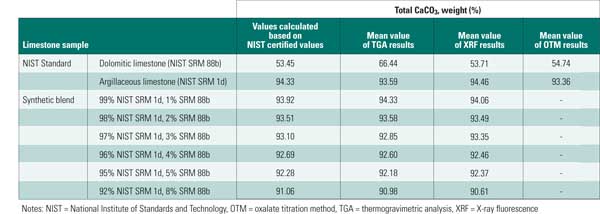
Table 2. Testing measurement accuracy. Hateful CaCO3 testing was conducted to compare the accuracy of each measurement technique on two NIST-certified standard limestone samples and on six blends of those limestones. Source: B&Due west
The results showed that all methods provided an authentic estimate for the full CaCO3 content of NIST SRM 1d. For 88b, XRF afforded the most accurate measurement of total CaCO3, every bit compared to certified values. Results using the oxalate titration method were slightly college than expected, only they were allowable. TGA results were biased loftier for this sample. Some of this overestimate was likely caused by the assignment of magnesium in the magnesian calcite phase to full CaO. Highly dolomitic stones are unlikely to be used in WFGD systems. Therefore, though TGA may have a bias in this range, it is an appropriate method for limestones with magnesium content in the range encountered in commercial WFGD application.
Determine Magnesium Carbonate Content. Determining magnesium content is another important aspect of limestone compositional analysis. This testing arroyo illustrates the key differences between TGA and elemental techniques, including XRF and moisture chemical science. XRF and other elemental techniques provide a value for magnesium based upon the total magnesium content detected within the species, expressed equally MgO or MgCOthree. Manufacture convention is to assume that all MgCOthree reported from elemental analysis is spring equally dolomite in a 1:ane atomic ratio with CaCO3.
In dissimilarity, TGA is a concrete technique that yields different results depending upon the degree of dolomitization of the limestone sample, as CO2 will exist evolved from highly calcitic and highly dolomitic mineralogical phases at different temperatures. Therefore, results for the dolomitic magnesium carbonate content reported past TGA should exist lower than XRF results for total magnesium, expressed as MgCO3. This lower value results from the difference between the total MgCO3 and the MgCOthree strongly bound in a dolomitic matrix, likely equating to the magnesium bound as magnesian calcite.
All three methods underestimated the total MgCO3 content of the NIST 1d. This may be due to the very low concentration of MgCO3 nowadays in this sample. The six command blends were created to accost this concern, exhibiting a range of MgCO3 content. XRF and the ammonium phosphate gravimetric method afforded similar results for the dolomitic limestone, agreeing well with certified values. TGA results were lower for the dolomitic limestone, as this method quantifies dolomitic MgCO3 rather than full MgCOiii content.
We observed that average XRF results provide a ameliorate indication of total MgCO3 when compared to TGA results, though some of this may be attributed to differences in mineral phase (Table three).
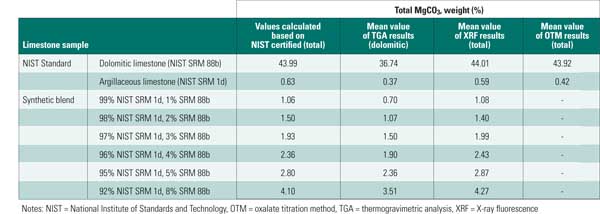
Table 3. Mean MgCO3 test results. Source: B&W
Overall, XRF provided authentic estimation of the full magnesium carbonate content for these samples, only it could not provide an indication of mineralogical phase. TGA results provided an acceptable interpretation of dolomitic MgCO3 content. Additional evolution of TGA would be required for quantification of the magnesium in magnesian calcite.
Determine Total Available Calcium Carbonate. The main purpose of obtaining compositional data about the CaCO3 and MgCOthree content of a given limestone is to make up one's mind the available CaCOthree. Available CaCOiii is the corporeality of CaCOiii within a limestone expected to react within a WFGD scrubber.
Total available calcium carbonate is calculated past subtracting the dolomitic carbonate contribution from the total carbonate of a sample. Total available CaCO3 is calculated from TGA results by subtracting one molecule of CaCO3 for every molecule of dolomitic MgCO3 measured. Considering magnesian calcite is credited toward total CaCO3, this alkalinity would be credited toward total available alkalinity. In dissimilarity, indication of mineral phase partitioning is beyond the capability of elemental analysis. Therefore, the convention is to assume that all the magnesium exists entirely every bit dolomite, ((Ca,Mg)(CO3)2), with a 1:1 ratio of CaCOiii and MgCO3. This cardinal difference is important to recognize only may not be significant due to the low concentrations of nondolomitic magnesium carbonate in many WFGD reagent limestones.
Analyses of filtrates from WFGD slurry samples indicate that dissolved magnesium concentrations range from several hundred to several 1000 parts per million. The concentration is very dependent on the chloride content of the coal and the chloride concentration maintained past the purge stream. Yet, it is apparent from this data that considerable MgCO3 is dissolved in WFGD systems. In some cases, utilities will provide a value for MgCOiii utilization; typical values range from xx% to 35%. Research and development projects aimed at developing a correlation for predicting the available MgCO3 are in progress.
TGA and XRF provide fantabulous understanding with expected values for total available CaCO3 (Table 4). TGA results were slightly higher for near samples than XRF or the NIST-certified values. Much of this departure may be attributed to the magnesium credited toward available alkalinity past the TGA method.
TGA did provide an overestimate of the full bachelor CaCO3 in NIST SRM 88b. This divergence could be due to consignment of some of the total MgCO3 toward the full alkalinity, or the bias in total CO2 evolved observed for this sample. Both TGA and XRF are adequate for decision of the total available CaCO3 in limestones used for WFGD.
Limestone Reactivity Testing
Decision of limestone reactivity is essential for accurate modeling and blueprint of WFGD systems. Because reactivity is a measure of the rate at which a limestone volition provide alkalinity to react with the acid created during And so2 dissolution and hydrolysis, it is used in estimating the amount of limestone that must be fed into the absorber to maintain a given pH for a particular Ca/S stoichiometry and solids residence fourth dimension. This data tin can and so be used in the initial design of the WFGD system.
Nevertheless, when a limestone possessing lower than design reactivity is used, feed rates would increase over those adult for the reactive limestone in order to maintain pH and SOii removal. As a result, gypsum purity would decrease due to increased inerts and unreacted CaCO3 and MgCO3 fed to the dewatering system. The period rates of waste material streams may also increase.
Currently, an industry standard for reactivity is not available, and a number of different procedures exist for conducting reactivity measurements. A test method is nether evolution by ASTM; Babcock & Wilcox (B&Due west), utilities, limestone suppliers, and other original equipment manufacturers are supporting this effort by serving on the task group. The following test method was developed by and are currently used by B&West to conduct limestone reactivity analysis:
-
Sample training. Repeatable sample training is essential, as differences in limestone grind will produce dissimilar initial particle size distributions (PSD).
-
PH and automatic titrator control settings. Tight organization control should be employed to ensure abiding pH and controlled acid addition. Undershoot and overshoot of pH are to be minimized because swings in pH will change the reaction rate, rendering results inconclusive.
-
Acrid. Because direct reaction betwixt limestone and the anion species does not occur once the acid has dissociated, hydrochloric acid (HCl) may exist used for limestone titration. The resulting products remain soluble, leaving unreacted limestone and inert species equally the only particulates within the solution. When sulfuric acid (Hii SO4) is used as the titrant, gypsum product is produced, precluding measurement of limestone PSD after the outset of reaction and leading to the potential for electrode scaling and fouling.
-
Common ion concentration. Due to the principles of chemic equilibrium, the charge per unit of the reaction is affected by the relative concentrations of products and reactants within solution.
-
Wetting agent. Apply of a wetting agent ensures that all of the sample expanse is available for heterogeneous reaction. Ideally, the wetting agent also acts as a dispersant, reducing error potential from sample agglomeration.
-
Correction for initial PSD. B&W has tested the same limestone that has been ground to unlike degrees of fineness. Results indicate that the empirically determined value for the reaction rate will not be constant unless information technology is corrected for PSD.
Reactivity Testing Methodology
The B&West limestone reactivity test method is used to ascertain the rate abiding of a limestone sample and to qualify candidate limestones for suitability as WFGD reagents with regard to this parameter. This method uses an automatic titrator to add HCl to a fixed corporeality of limestone sample. The automated titrator includes an agitator and provides precise control over the titration, which is necessary when determining the rate of reaction. PSD measurements are taken to provide an estimate of the limestone surface area available for reaction. Titration results and PSD measurements are used to estimate the reactivity constant of a given limestone. Results are compared to a limestone of known field performance.
To fix the sample, the limestone is pulverized in a disk manufactory and screened such that 100% passes through 325 mesh. By using a abiding mill setting during grinding, and by screening the sample, some control over PSD is afforded. However, obtaining two samples with the same PSD is highly unlikely, even from the same screening. This is primarily due to differences in the Bond Work Alphabetize of the different limestone samples. Double screening is not used due to concern that error may be induced through such activity as, theoretically, fractions of differing composition may upshot above and below the smallest screen.
Within a WFGD organization, limestone is thought to react with the hydrogen ions in solution resulting from SO2 dissolution and its subsequent hydrolysis in water. Because limestone does non react directly with SO2 just, rather, reacts with the protons released from its absorption, any acid may be used to model the reaction of limestone and acid. B&W chooses to utilize HCl for limestone reactivity testing because the products of this reaction remain soluble in water, affording PSD measurements at afterwards stages in the reaction.
A 1-gram sample of the prepared limestone is titrated with HCl in an automatic titrator until complete reaction at a pH of iii.85. Employ of a compatible wetting agent is disquisitional to allow wetting of the limestone sample and to ensure consummate dispersion of the limestone sample particles. The volume of acid added is recorded, and this upshot is used to determine full alkalinity of the limestone sample. From analysis of the titration results, the amount of HCl required to titrate 60% of the total alkalinity is calculated.
A second 1-gram sample from the aforementioned screening is prepared and titrated at a pH of 5.0 until the calculated volume of acid required to react threescore% of the full alkalinity has been added. Results are recorded as volume of acid added as a function of time (Figure three).
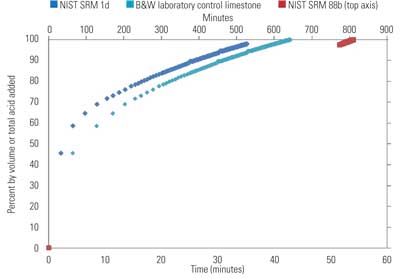
3. Book of acid added vs. fourth dimension for 60% titration of a limestone'due south alkalinity. The NIST SRM 88b sample data uses the secondary axis time scale located on top. Source: B&W
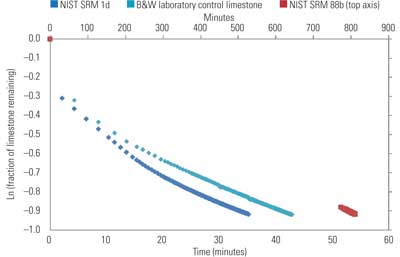
4. Natural log of the fraction of limestone remaining vs. fourth dimension. The NIST SRM 88b sample data uses the secondary axis time calibration located on top. Source: B&West
During data analysis, the sixty% titration data, original sample mass, and total alkalinity of the sample are used to construct a curve for the natural log of the limestone fraction remaining every bit a function of time (Figure iv). The derivative of this curve at the endpoint of titration is used in calculation of the reaction rate abiding. PSD measurements for the sample are obtained at the titration endpoint to stand for with this slope.
A PSD reading is and then taken on an aliquot of titrated sample. The initial and inert PSDs are also measured. The PSD readings are used to determine the specific surface area, expressed as the Sauter mean diameter (SMD), of the alkaline species in the sample at the titration endpoint. The alkaline metal particles are assumed to be spherical. The SMD and the charge per unit of acid addition are used to determine a reaction rate constant with units of microns of alkali metal particles reacted per minute. The rate constant is independent of the actual particle size.
The B&West laboratory command limestone is a WFGD reagent limestone of known field operation, and this stone reacted in a similar menstruum of time to NIST SRM 1d. In stark contrast, the dolomitic command limestone required almost 14 hours to reach 60% reaction at a pH of 5.0. Such a limestone is not suitable for use in WFGD systems.
Reactivity results for these limestones, and for reagent grade CaCOiii normalized to the B&W control limestone, are provided in Table five. Large variances in reactivity betwixt the control stone, argillaceous limestone, and reagent form CaCO3 are thought to be attributed to differences in initial particle size distribution and sample training methods, every bit all of these should provide adequate performance in a WFGD system. Observe that the dolomitic limestone just exhibited 1% of the reactivity of the B&West control limestone, indicating that it would be unreactive in most WFGD systems.

Table 5. Relative reactivity of various limestones. Source: B&W
Testing to amend this method continues, with a main focus on developing a correlation for initial particle size distribution. Preliminary results for the relative reactivity of samples of the same limestone ground to three different particle size distributions indicate that initial PSD may accept significant impact on the reaction rate abiding, every bit empirically determined from typical acrid titration based reactivity methods.
XRF results provided by Don Broton, senior scientist of CTL Group Inc.
Normal
0
0
i
29
170
one
ane
208
11.0
0
0
0
Source: https://www.powermag.com/techniques-for-determining-limestone-composition-and-reactivity/
0 Response to "How Does an Element Family Group Determine Its Reactivity With Water"
Postar um comentário